Three words. Every channel. One human.
Voice call, video conference, text message, email, QR — the same code proves the same person, everywhere the conversation goes.
AI clones any voice and face — and attackers no longer pick one channel. They follow the deepfake call with a 'confirming' email and a text-message follow-up. One question closes every door at once: "What's your code?" If the three words match, it's really them. If not — hang up, delete, walk away.
Try Business free for 14 days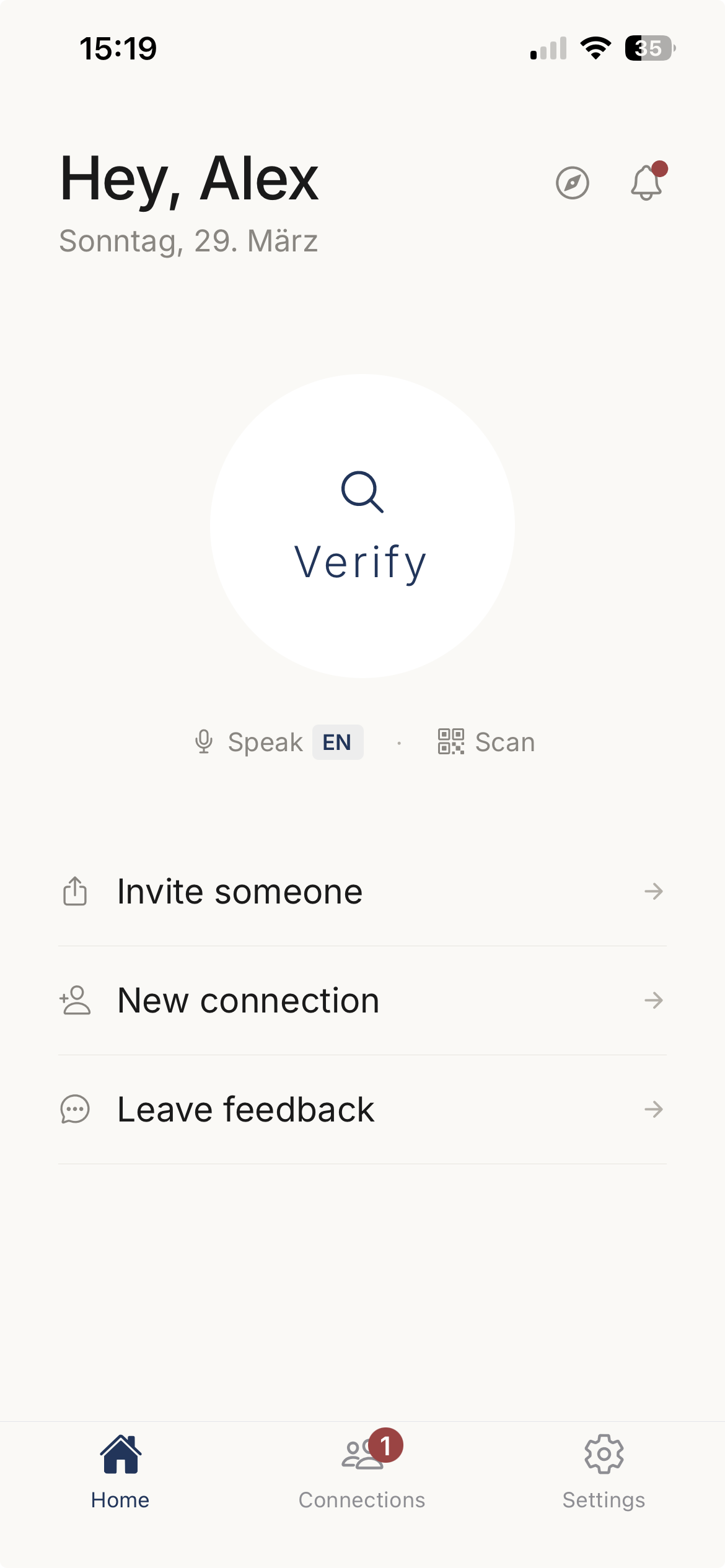
The cross-channel attack
Fraudsters don't pick one channel. Your defence shouldn't either.
- Voice call
- Video conference
- Messaging
- QR / silent
- 1
A deepfake call confirms itself via a 'matching' email — then a text-message follow-up keeps the pressure on.
- 2
Channel-specific detectors guard one door at a time. The attacker just walks to the next one.
- 3
One code, asked in any channel, closes all of them.
One identity. Every surface the conversation touches.
This Already Happened
$1.3M stolen by fake 'bank fraud teams' in one Canadian city.
Between March and August 2025, 15 Calgary residents received calls from people claiming to be their bank's fraud team. The callers were convincing: they described unauthorised transactions and sent couriers to collect cards and PINs for 'safekeeping.' Three suspects aged 22–25 were arrested after search warrants executed on April 14–15, 2026. Total losses: $1.3 million. A bank-issued Trusted Code on the call would have stopped every one.
City of Calgary Newsroom · May 2026AI voice cloning needs just 3 seconds of audio. Your voicemail is enough.
Simple Verification
Verification in 3 seconds.
Shown: two people who both use Trusted Codes. A person without the app gets an invitation link and is guided through sign-up first.
Example Code
Mountain. Coffee. Bicycle.
Words create mental images. They stick. They're easy to say on any call, even when you're stressed.
Where it works
Same three words. Any channel.
However the conversation reaches you — verify the human in seconds.
- Phone or video callAsk "What's your code?" — they read three words.
- Text message or emailPaste or read the three words into the thread.
- Video conferenceShow the QR on screen — verified silently, no words spoken.
- Quiet room, can't speakTap-to-verify — silent handshake between two devices.
- AI agent / inboxMCP returns the code for the human you name, on demand.
One question stops every impersonator.
The Grandparent Scam
An AI-cloned voice of your grandson begs for bail money.
"What's your code, sweetheart?" Scammer hangs up.
The CEO Fraud
An "urgent" wire transfer request from the CFO — by deepfake.
Code check fails. $25 million saved.
The Fake Conference Call
A "client" joins a video call to change contract terms.
Three words expose the deepfake instantly.
A simple question protects against financial loss, data breaches, and family distress.
Built for trust.
End-to-end encrypted
Your codes are generated on your device. Even we can't see them.
Works completely offline
No internet needed. Travel, emergencies, poor signal — always protected.
GDPR compliant, EU hosted
All data stored in the European Union. Full data protection.
Free for families, forever
Protecting your loved ones shouldn't cost a thing.
Detection vs. verification
Stop trying to catch the fake. Start verifying the human.
Detection tools ask "is this video/voice/message fake?" — a question that gets harder every month. Verification asks "is this actually the person I think it is?" — a question that doesn't get harder as the fakes improve, because it doesn't depend on catching the fake at all.
Detection (the arms race)
- One tool per channel — separate products for video, voice, email
- Gets harder as fakes get better
- Defender pays more every cycle of the arms race
- User asks: "is this fake?"
- Mental load: which tool do I trust on which channel?
Verification (Trusted Codes)
- One layer across every channel
- Doesn't depend on spotting the fake at all
- One subscription, no model retraining
- User asks: "is this them?"
- Mental load: one habit, every channel
Detection tools keep improving, and you should keep using them. But they're a patch on individual channels. If the attack is cross-channel, the proof of authenticity has to be cross-channel too.
The Question That Matters
When their voice sounds perfect and their face looks real...
How will you know it's them?
Free for families
Up to 10 connections, forever free
Business
For teams and organisations
Try Business free for 14 days
Protection shouldn't be a luxury. Get started in 60 seconds.